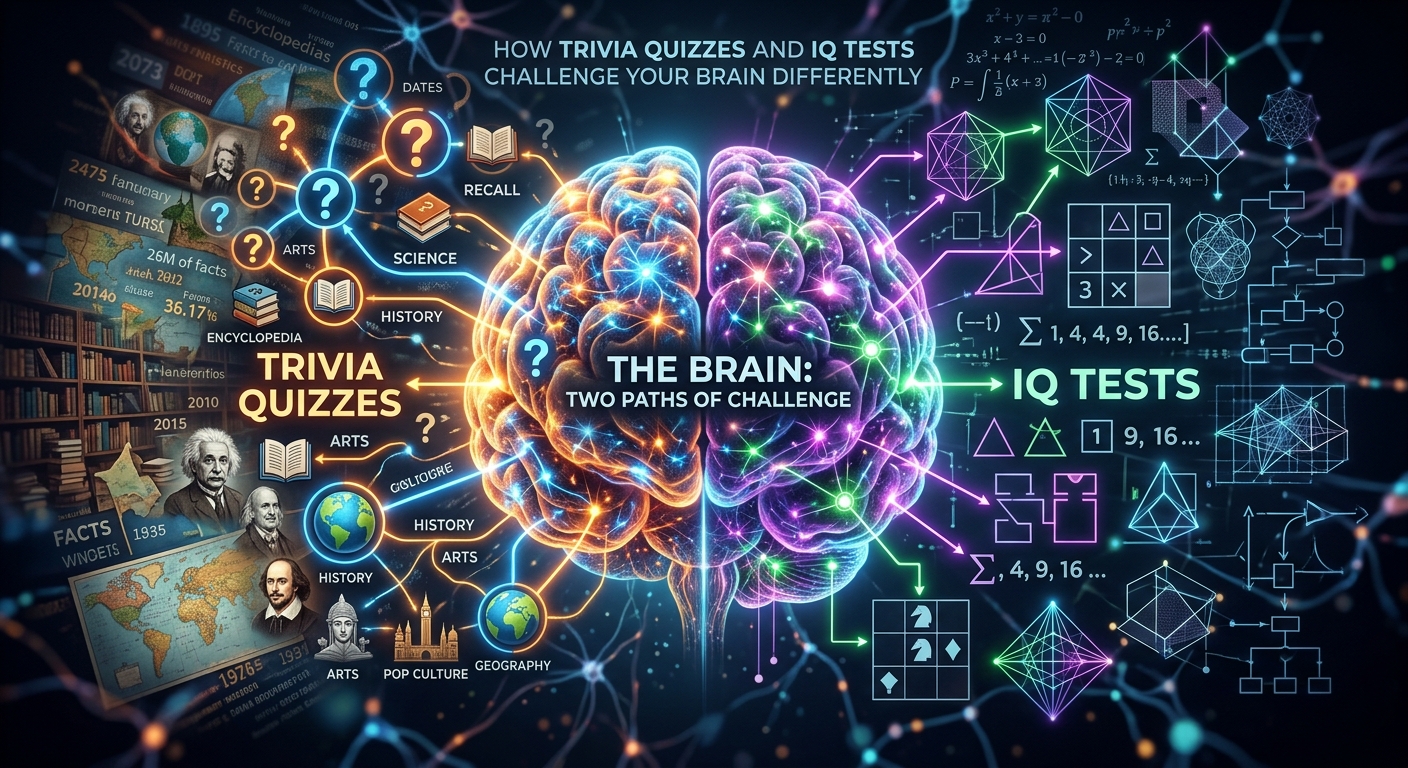
How Trivia Quizzes and IQ Tests Challenge Your Brain Differently
You crush every geography round at pub quiz night. Capitals? Easy. Obscure rivers? Done. But hand you a pattern-based reasoning puzzle and the confidence fades fast. This is not a personal flaw. It is a feature of two very different cognitive systems living inside the same brain, each sharpened by a different kind of challenge. Trivia and IQ-style tests do not measure the same thing. Understanding the difference changes how you practice, what you gain from your hobby, and how you think about your own mental strengths.
Trivia quizzes build crystallized intelligence, the vast knowledge you have stored over a lifetime of reading, watching, and paying attention to the world. IQ-style tests measure fluid intelligence, the raw processing power you bring to bear when solving brand-new problems from scratch. Both are real, distinct forms of cognitive ability. Training one does not automatically train the other. The most mentally sharp people work both systems deliberately, and often.
What Your Brain Is Actually Doing During a Trivia Quiz
Every time a quiz host reads a question, your brain launches a remarkable internal search. It scans an enormous library built from years of reading, watching, listening, and simply living. This process relies on crystallized intelligence, which is the accumulated knowledge and learned skill that builds up across your lifetime.
Psychologists use this term to describe the kind of intelligence that grows with experience. The more history books you read, science documentaries you watch, or sports commentary you follow, the larger your crystallized knowledge base becomes. Trivia is essentially a test of how well you have curated and stored that base over time.
Retrieval matters just as much as storage. Your brain is not just an archive. It is an active system. When you hear "What is the capital of Mongolia?" your hippocampus fires up a search. Good trivia players have trained this retrieval system through repeated exposure, exactly the kind of structured practice that regular quiz sessions provide.
Pattern recognition also plays a role. Experienced quiz players begin to sense category traps and misdirections inside questions. They notice that a question about a "famous painter born in Spain" is likely Picasso. That is not pure memorization. It is a learned heuristic built from hundreds of similar encounters over time.
The Science Behind IQ-Style Reasoning Tests
IQ tests are built around a different concept entirely. They aim to measure fluid intelligence, the capacity to reason through new problems without relying on previously learned facts. This includes working memory, processing speed, spatial reasoning, and the ability to identify abstract patterns in real time.
A classic IQ-style question might show you a sequence of shapes and ask what comes next. There is no capital city to name. There is no historical date to recall. You have to derive the answer through pure reasoning in the moment. That derivation is what the test is measuring.
Fluid intelligence peaks earlier in life than crystallized intelligence. Research suggests it reaches its height in the mid-twenties before gradually declining with age, while crystallized intelligence often keeps growing far into old age. This is why an older pub quiz veteran can dominate a younger opponent on knowledge rounds while possibly struggling with timed abstract puzzles. Both people may be highly capable. They are just strong in different dimensions at different stages of life.
IQ-style tests also tend to include strict time limits because processing speed is part of what they measure. The pressure is deliberate. It strips away the luxury of slow deliberation and forces you to work with what your mind can produce quickly under load.
Crystallized Vs. Fluid Intelligence: What Each Type Involves
| Dimension | Trivia Quizzes (Crystallized) | IQ-Style Tests (Fluid) |
|---|---|---|
| Core skill | Stored knowledge and recall | Abstract reasoning and pattern detection |
| Memory type used | Long-term semantic memory | Working memory and processing speed |
| Improves with | Reading, exposure, repeated quiz practice | Logic puzzles and novel problem-solving |
| Age trend | Grows across a lifetime | Peaks mid-20s, then gradually declines |
| Prior knowledge dependency | Heavily dependent on it | Designed to be independent of it |
| Typical format | Factual Q&A, multiple choice | Pattern sequences, analogies, spatial tasks |
Why Your Trivia Score and Your IQ Score Tell Different Stories
Here is where things get genuinely interesting. A person can score brilliantly on a trivia quiz and perform modestly on a fluid reasoning test. The reverse is also true. These are not contradictory results. They reflect two genuinely separate systems that can operate independently of each other.
A student who grew up without much access to books may have high fluid intelligence but a smaller crystallized knowledge base. A lifelong reader and quiz fanatic may have an enormous store of facts but less experience with abstract spatial puzzles. Neither person is more intelligent in some absolute sense. They are strong in different dimensions.
This is also why training for IQ-style tests is harder than training for trivia. You cannot memorize your way to better fluid reasoning the way you can memorize capitals and prime ministers. You can practice the format and become more familiar with how the questions work, but the underlying reasoning capacity resists rapid change in a way that factual recall simply does not.
Trivia, by contrast, is highly trainable. More exposure means more stored knowledge. More stored knowledge means better scores. It is a direct and rewarding feedback loop, which is part of what makes quiz culture so addictive for the people who fall into it.
Benchmarking Your Fluid Reasoning Separately from Your Trivia Score
If you have ever been curious about where your fluid reasoning actually sits, you can get a baseline without visiting a psychologist's office. A mini IQ test gives you a concrete starting point for that second dimension, completely separate from anything your trivia record tells you. Think of it as a complementary reading rather than a competing one.
Taking that kind of test while also tracking your trivia performance gives you a fuller picture of your cognitive profile. You might find a gap. Most people do. The useful question is not which score is higher but what each one tells you about where to direct your attention next.
Results on fluid reasoning tasks can shift over time with targeted practice. Logic puzzles, strategy games, and novel problem-solving tasks are the training ground for that system. It is not glamorous work, but consistent effort accumulates in ways that show up months later.
What Regular Trivia Play Builds in Your Brain Over Time
People often underestimate what sustained trivia practice does to the brain. It is not just about accumulating isolated facts. It is about building a richer associative network where different pieces of knowledge connect to each other in surprising and useful ways.
This is sometimes called schema development. The more you know about a topic, the easier it is to absorb and retain new information in that same area. A trivia player who knows a lot about medieval history will find it much easier to pick up new facts about that period than someone starting from scratch. Knowledge genuinely compounds.
Regular quiz play develops more than factual recall. It also builds:
- Associative memory networks that link facts across different topics and categories
- Confidence in making committed decisions quickly under time pressure
- Vocabulary and linguistic pattern recognition across multiple domains
- Broad awareness spanning history, culture, science, and geography
- Mental stamina for sustained focus in competitive environments
These are cognitive habits that carry into everyday life far beyond quiz night. The discipline of paying close attention to the world around you, because anything might become a question one day, trains a particular kind of engaged curiosity that is genuinely useful across all sorts of contexts.
Practical Ways to Build Both Types of Intelligence
Trivia practice and fluid reasoning practice can coexist in your routine. They just need to be approached separately and with different tools in mind.
To build your crystallized knowledge base more effectively, the following approaches are proven:
- Play across varied topic categories, not just the subjects you already love
- Review every wrong answer rather than moving past it without reflection
- Read across history, science, culture, and current affairs with real intention
- Use active recall when studying new material rather than passive re-reading
- Play with people who know different things and pay attention to what they know
To build fluid reasoning, the toolkit looks quite different:
- Spend regular time with pattern-based puzzles such as Sudoku, nonograms, or visual logic games
- Play strategy games that require planning several moves ahead of the current position
- Tackle reasoning problems with strict self-imposed time limits to train processing speed
- Take periodic timed reasoning tests to track your baseline across months and spot any change
- Prioritize sleep and physical activity, as both have strong evidence behind their effects on cognitive function
Two Scores, One Sharper Mind: Making Both Work for You
The trivia community and the IQ testing world have rarely spoken to each other. But the people who thrive in high-stakes quiz settings tend to have both things working for them. A deep knowledge base covers the questions they have encountered in some form before. Fast, flexible reasoning covers the ones they have not seen coming.
You do not need to choose one or the other. You can use your quiz habit to keep building crystallized intelligence while adding short, deliberate sessions of pattern-based reasoning work to your week. Over months, that combination adds up to something genuinely different from either practice alone.
The quiz library here gives you a structured path for the knowledge side of that equation. Thousands of questions across history, science, geography, sport, and culture represent exactly the kind of broad, varied exposure that builds a richer crystallized knowledge base over time. Use it often. Use it across categories you do not yet own. Then pair it with some deliberate fluid reasoning practice on the side.
Your trivia score tells you how much you know. Your reasoning baseline tells you how clearly and quickly you think. Both matter. Both improve with the right kind of attention. And now you have a framework to train them properly.
Put your knowledge to the test
Play free quizzes on hundreds of topics — from history and science to pop culture and geography.