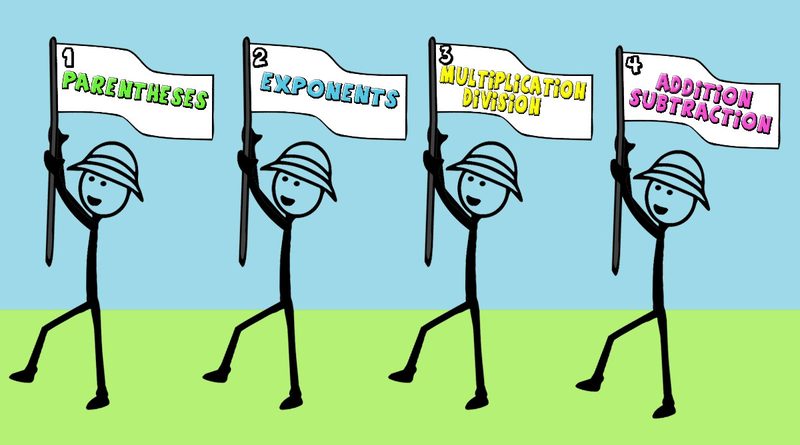
The Order of Operations is a crucial guideline in mathematics that dictates the correct sequence for evaluating expressions. This principle is often remembered by the acronym PEMDAS, which stands for Parentheses, Exponents, Multiplication and Division (from left to right), Addition and Subtraction (from left to right). The formalization of this concept emerged in the 19th century, with contributions from mathematicians like Augustus De Morgan and Charles Sanders Peirce. Understanding the Order of Operations is essential for avoiding miscalculations, especially in complex equations.
History of the Order of Operations
The concept of an established Order of Operations can be traced back to the early days of mathematical notation. In the 1800s, mathematicians began to recognize the need for a standardized approach to ensure clarity in mathematical expressions. The notation system evolved significantly with the works of René Descartes and Gottfried Wilhelm Leibniz, who both influenced the development of modern algebra. The introduction of PEMDAS as a mnemonic device helped students remember the sequence, further solidifying the concept within educational curricula.
The Importance of Order in Calculations
Without a defined Order of Operations, mathematical expressions could yield vastly different results based on the method of evaluation. For example, in the expression 3 + 6 × 2, following the Order of Operations leads to 3 + 12 = 15, while evaluating from left to right would incorrectly yield 9. This principle is not only crucial in academic settings but also in programming, engineering, and various scientific fields where precision is paramount.
Our quiz challenges your understanding of the Order of Operations, covering its history, importance, and applications. Test yourself and see how well you grasp this essential math concept!
 Multiple Choice
No comments yet. Be the first!