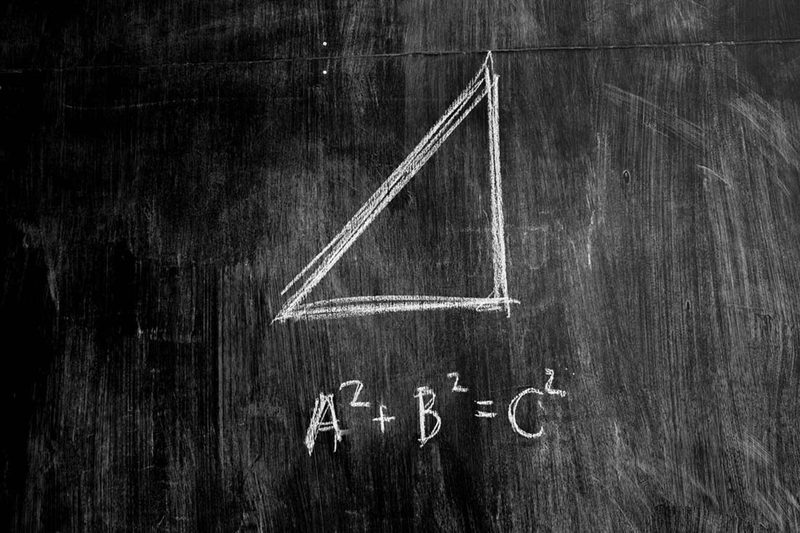
The Pythagorean Theorem is a cornerstone of mathematics, stating that in a right triangle, the square of the length of the hypotenuse is equal to the sum of the squares of the lengths of the other two sides. This theorem, attributed to the ancient Greek mathematician Pythagoras, has been used for over two millennia, influencing countless mathematicians and scientists, including Euclid and Isaac Newton. The theorem is not only pivotal in theoretical mathematics but also has practical applications in various fields such as architecture and navigation.
History of the Pythagorean Theorem
The origins of the Pythagorean Theorem can be traced back to ancient civilizations, with early evidence found in Babylonian mathematics, long before Pythagoras' time. The oldest known record of the theorem is the Babylonian tablet known as YBC 7289, which dates back to approximately 1800 BCE. Pythagoras, who lived around 570-495 BCE, is credited with its formal proof and for founding a religious movement that emphasized the importance of numbers. His followers, the Pythagoreans, expanded on his ideas and contributed significantly to mathematics.
Applications of the Pythagorean Theorem
The Pythagorean Theorem has far-reaching applications beyond pure mathematics. In the field of architecture, it is used to ensure structures are built with right angles, which is critical for stability. In navigation, it helps determine the shortest path between two points. Additionally, in physics, the theorem is essential for calculating distances and understanding the relationships between different forces in a right-angled framework. Its versatility makes it an invaluable tool across various disciplines.
Legacy and Influence
Pythagoras’ influence extends beyond mathematics into philosophy and science. His theorem laid the groundwork for trigonometry and has been foundational in the development of mathematical proofs. Over the centuries, mathematicians like Euclid and Leonhard Euler have built upon Pythagoras' work, applying it in countless ways. The theorem continues to be taught in schools worldwide and remains a vital part of the mathematical toolkit.
Test your understanding of the Pythagorean Theorem with this quiz, which covers its history, applications, and legacy. Can you score 10/10?
 Multiple Choice
No comments yet. Be the first!