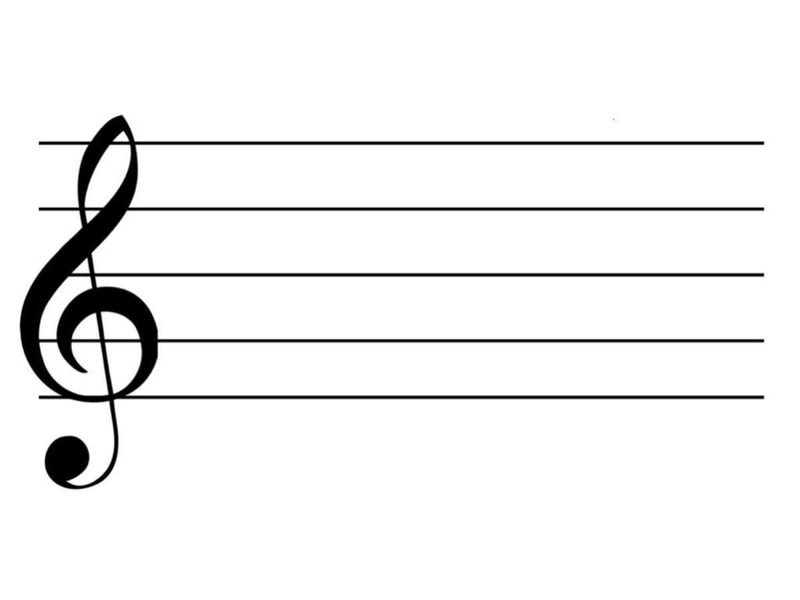
The treble clef, often referred to as the G clef, is a symbol used in musical notation that indicates the pitch of written notes. It was developed in the early 16th century and is primarily used for higher-pitched instruments and voices. This clef encircles the second line of the staff, which corresponds to the note G4, establishing a reference point for the subsequent notes. Composers like Wolfgang Amadeus Mozart and Johann Sebastian Bach utilized this notation extensively, showcasing its importance in the evolution of Western music.
History of the Treble Clef
The origins of the treble clef date back to the Renaissance period. Initially, musical notations were rudimentary, lacking a standardized system. The treble clef emerged to provide clarity, allowing musicians to read and write music more effectively. In 1580, the clef was formally recognized, making it a crucial element in the evolution of music theory. Its design, resembling a stylized letter 'G', indicates the second line of the staff, marking the pitch for a range of instruments, including the violin and flute.
The Importance of the Treble Clef
The treble clef serves a fundamental role in music education and performance. It is essential for conductors, vocalists, and instrumentalists, as it provides a framework for understanding note placement and pitch. Musicians learn to read the notes on the treble staff, which include the line notes E, G, B, D, and F, and space notes F, A, C, and E. Mastering these notes is vital for any musician looking to excel in their craft, as they form the basis of much of the music repertoire.
Ready to challenge yourself? This quiz covers essential facts about the treble clef, including its history, significance, and the notes associated with it. See if you can score 10/10!
 Multiple Choice
No comments yet. Be the first!