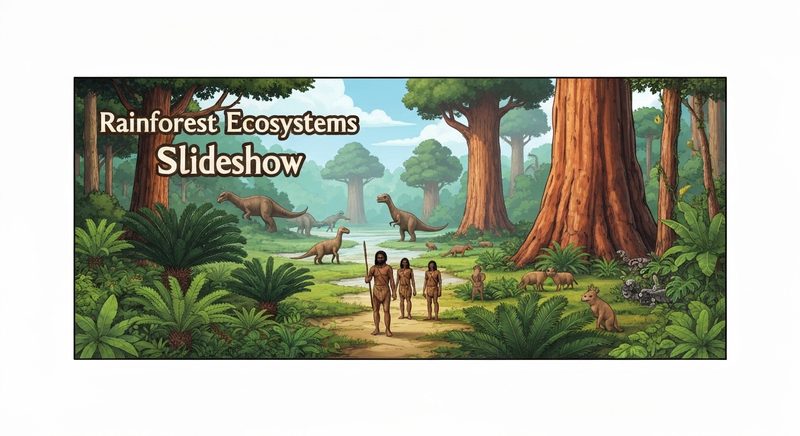
Rainforests are among Earth's oldest and most complex terrestrial ecosystems, with a rich geological history spanning millions of years. These ancient biomes began to form hundreds of millions of years ago, evolving into the incredibly biodiverse regions we know today. Over millennia, through cycles of continental drift and climatic shifts, these vital ecosystems have persisted and adapted, becoming critical reservoirs of life and genetic diversity. They represent a living historical record of evolution, teeming with species that have co-evolved in intricate webs of interdependence.
Layers of Life: The Vertical World of Rainforests
The structure of a rainforest is often described in distinct vertical layers, each supporting unique communities of life. The uppermost, emergent layer, features giant trees like the kapok, reaching over 200 feet and home to eagles. Below this is the dense canopy, forming the primary habitat for monkeys, sloths, and countless bird species, hosting up to 90% of rainforest organisms. The understory fosters shade-loving plants and animals like jaguars and red-eyed tree frogs. Finally, the forest floor is a dark, humid environment where decomposition rapidly recycles nutrients, sustaining creatures like tapirs and army ants.
Biodiversity Hotspots and Unique Species
Rainforests are unparalleled biodiversity hotspots, housing an extraordinary concentration of life. Covering less than 6% of Earth's land, they are home to over half the world's plant and animal species, many found nowhere else. The Amazon Rainforest, the largest tropical rainforest, alone boasts an estimated 390 billion trees and over 2.5 million insect species. Other significant rainforests include the Congo, known for its gorillas and okapis, and Southeast Asia, home to orangutans and tigers. These ecosystems are a treasure trove of genetic material, providing resources from medicinal plants like the rosy periwinkle to essential food crops.
The Human Impact and Conservation Imperative
However, these magnificent ecosystems face unprecedented threats, primarily from human activities. Deforestation, driven by logging, cattle ranching, agriculture, and mining, is destroying rainforests at an alarming rate, with an estimated 80,000 acres lost daily globally. This rapid destruction leads to the extinction of countless species and significantly contributes to climate change, as rainforests act as crucial carbon sinks. The loss of the Amazon alone could have catastrophic global consequences for weather patterns and biodiversity. Protecting these vital 'lungs of the Earth' is critical for the planet's ecological balance and the future of all life.
Want more History trivia? Try our US History Slideshow, test your knowledge with the European History Quiz, journey back in time with the Ancient Egypt Quiz, or see if you can Order the US Presidents Chronologically!
 Slideshow
No comments yet. Be the first!