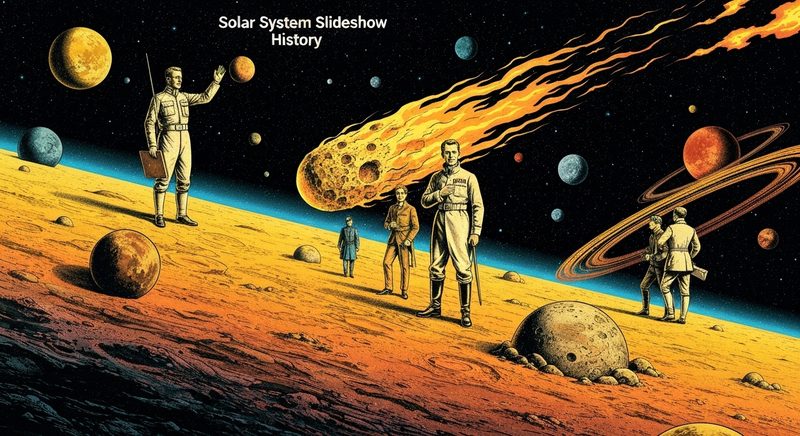
Our Solar System is a gravitationally bound system of the Sun and the objects that orbit it. It formed approximately 4.6 billion years ago from the gravitational collapse of a giant interstellar molecular cloud. The vast majority of the system's mass resides in the Sun, with the remaining 0.14% contained mostly in the eight planets. These planets are divided into the inner, rocky terrestrial planets (Mercury, Venus, Earth, Mars) and the outer, gaseous giant planets (Jupiter, Saturn, Uranus, Neptune), separated by the asteroid belt. Beyond Neptune lies the Kuiper Belt and the more distant Oort Cloud, home to countless icy bodies and dwarf planets.
The Sun and Inner Planets: A Fiery Beginning
At the heart of our Solar System lies the Sun, a G-type main-sequence star accounting for 99.86% of the system's total mass. Closest to this star are the four terrestrial planets: Mercury, Venus, Earth, and Mars. Mercury experiences extreme temperature swings, while Venus, often called Earth's 'sister planet,' boasts a runaway greenhouse effect making it the hottest planet. Earth, our unique blue marble, is the only known planet to harbor life. Mars, the Red Planet, is home to the largest volcano, Olympus Mons, and has been extensively explored by rovers like Perseverance.
The Majestic Gas Giants and Their Diverse Moons
Beyond the asteroid belt reside the four gas giants: Jupiter, Saturn, Uranus, and Neptune. Jupiter, the largest planet, is more than twice as massive as all other planets combined and is famous for its Great Red Spot. Its four largest moons - Io, Europa, Ganymede, and Callisto, discovered by Galileo Galilei - Are known as the Galilean moons. Saturn is instantly recognizable by its spectacular system of rings, composed mainly of billions of ice particles. Its largest moon, Titan, is unique for having a dense atmosphere and stable bodies of liquid methane and ethane on its surface. Uranus and Neptune, often called ice giants, are characterized by their deep, cold atmospheres and faint ring systems.
Dwarf Planets, Distant Realms, and Human Exploration
Beyond the eight planets, countless other fascinating objects exist. The asteroid belt, between Mars and Jupiter, contains millions of rocky bodies, including the dwarf planet Ceres. Further out, beyond Neptune, lies the Kuiper Belt, a vast region of icy bodies, including dwarf planets like Pluto, Haumea, and Makemake. This region is a remnant from the Solar System's formation and a source of many comets. Human exploration has greatly expanded our understanding, with missions like the Voyager 1 and 2 probes, launched in 1977, now exploring interstellar space. The Hubble Space Telescope has also delivered iconic images, revealing the beauty and complexity of our cosmic neighborhood.
Want more History trivia? Try our US History Slideshow, test your knowledge with the Ancient Egypt Quiz, or delve into European History Quiz. For another visually engaging challenge, explore the Periodic Table Slideshow.
 Slideshow
No comments yet. Be the first!