The concept of standardized time zones emerged in the late 19th century as railway travel made differing local times impractical and dangerous. Before this, each town kept its own local time, usually based on solar noon. Sir Sandford Fleming, a Canadian railway engineer, is largely credited with proposing a worldwide system of time zones in 1879, leading to the International Meridian Conference in Washington D.C. in 1884. This conference established the Greenwich Meridian as the prime meridian, setting the stage for Greenwich Mean Time (GMT) as the global standard, which later evolved into Coordinated Universal Time (UTC) in 1960.
The Global Grid: From UTC-12 to UTC+14
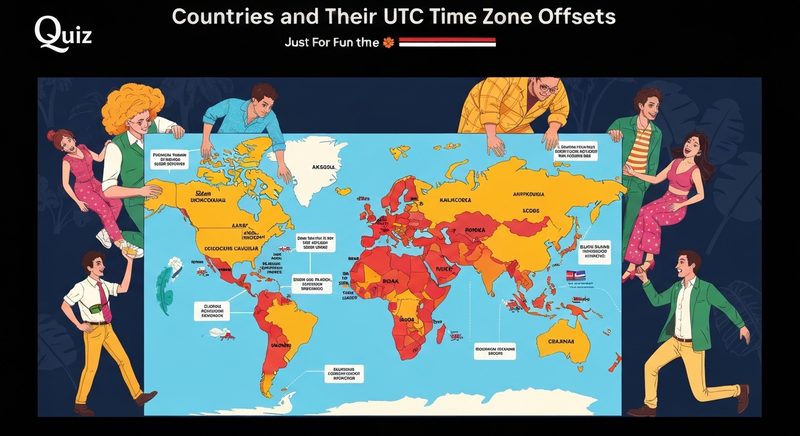
Our planet is divided into 24 theoretical primary time zones, each roughly 15 degrees of longitude wide, designed to keep local time aligned with the sun's position. These zones range from UTC-12, encompassing the uninhabited Baker Island and Howland Island in the Pacific, to UTC+14, which includes parts of Kiribati and Tonga, making them some of the first places to see the new day. While many countries adhere closely to these theoretical divisions, others, like Russia, span multiple time zones, yet may consolidate their official times for practical reasons. The International Date Line, a crucial but often jagged boundary, generally follows the 180th meridian, determining where one day ends and the next begins.
Political Time and Practical Adjustments
Time zones are not purely geographical; political and economic factors often play a significant role in their adoption. A prime example is China, which, despite its massive size spanning approximately 60 degrees of longitude (roughly five natural time zones), officially observes a single time zone, Beijing Time (UTC+8), across the entire country since 1949. This decision, aimed at national unity, means that in western regions like Xinjiang, the sun may not set until well after midnight by the clock. Similarly, India uses a single UTC+5:30 offset, a half-hour deviation from standard hourly increments, a common practice in countries like Afghanistan (UTC+4:30) and Iran (UTC+3:30) as well.
Fascinating Shifts and Anomalies
The history of time zones is filled with intriguing shifts and unique anomalies. In 2011, the Pacific island nation of Samoa famously jumped forward by a day, moving its official time zone from UTC-11 to UTC+13, effectively skipping December 30th entirely, to better align with its major trading partners, Australia and New Zealand. This dramatic change repositioned Samoa to be one of the first countries to greet the new day. Another curious case is Lord Howe Island, off the coast of Australia, which observes UTC+10:30, making it one of the few places with a half-hour daylight saving offset. These exceptions highlight the dynamic and often complex nature of global timekeeping.
Want more Just For Fun trivia? Try our Identify the Country by Its Flag, test your knowledge with World Currencies Slideshow, challenge yourself with the Largest Countries in the World by Area, or explore the World Rivers and Their Lengths.
 Table
Table
No comments yet. Be the first!