Biology, the scientific study of life, boasts a rich history spanning millennia. Early philosophers like Aristotle made significant observations and classifications of living organisms. The invention of the microscope in the 17th century by figures such as Robert Hooke - Who coined the term "cell" - And Antonie van Leeuwenhoek, who first saw bacteria and protozoa, revolutionized our understanding of microscopic life. Later, Carl Linnaeus established a hierarchical system of classification in the 18th century that remains largely in use today.
The Blueprint of Life: Genetics and DNA
The field of genetics fundamentally transformed in the mid-19th century with Gregor Mendel's meticulous experiments on pea plants, revealing the basic principles of heredity and the existence of genes. A century later, in 1953, James Watson and Francis Crick, building on crucial X-ray data from Rosalind Franklin, unveiled the double helix structure of DNA - The molecule carrying genetic instructions. This discovery unlocked secrets of how genetic information is stored and passed down, culminating in monumental projects like the Human Genome Project, which mapped the entire human genetic code between 1990 and 2003.
Evolutionary Journeys and Earth's Biodiversity
One of biology's most profound concepts, evolution by natural selection, was famously articulated by Charles Darwin in his seminal 1859 work, 'On the Origin of Species.' Concurrently developed by Alfred Russel Wallace, this theory proposed that all species of life have descended from common ancestors, driven by advantageous traits becoming more prevalent. This mechanism explains Earth's incredible diversity, from single-celled organisms to complex ecosystems. Understanding evolutionary biology is crucial for comprehending how species adapt, the mechanisms of speciation, and the ongoing importance of preserving biodiversity.
The Microcosm Within: Cells and Body Systems
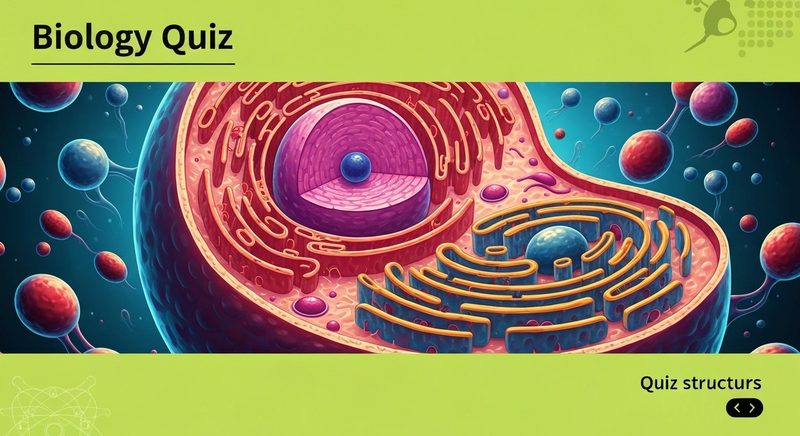
At the heart of all life lies the cell, the fundamental structural and functional unit of every living organism. The unified cell theory, solidified in the mid-19th century by Matthias Schleiden, Theodor Schwann, and Rudolf Virchow, established that all living things are composed of cells and arise from pre-existing cells. Within these microscopic powerhouses are intricate organelles, each with specialized functions - From mitochondria generating energy through cellular respiration to chloroplasts performing photosynthesis. Beyond individual cells, complex organisms exhibit sophisticated physiological systems like the nervous and circulatory systems, working in concert to maintain homeostasis, essential for survival.
Want more Science trivia? Try our Planets of the Solar System: Name to Diameter quiz to explore astronomy, challenge your understanding of life's building blocks with our Cell Organelles Quiz, delve into specialized tissues with the Connective Tissue Quiz, or explore pivotal discoveries in our Science Breakthroughs Slideshow!
 Classic
No comments yet. Be the first!