The microscopic world of cells, the fundamental units of life, began to unfold in the 17th century. In 1665, Robert Hooke published 'Micrographia,' describing the 'cells' he observed in cork. Simultaneously, Anton van Leeuwenhoek, with his superior single-lens microscopes, became the first to observe living 'animalcules.' These observations laid the foundation for the unified cell theory, formulated by Matthias Schleiden and Theodor Schwann in the late 1830s, asserting that all living things are composed of cells. This theory was extended by Rudolf Virchow in 1855, proposing that all cells arise from pre-existing cells.
The Fundamental Divide: Prokaryotes and Eukaryotes
The biological world is broadly categorized into two primary cell types: prokaryotic and eukaryotic. Prokaryotic cells, including bacteria and archaea, are structurally simpler, lacking a true nucleus and other membrane-bound organelles. Their genetic material floats freely, typically ranging from 0.1 to 5 micrometers. In contrast, eukaryotic cells - Found in animals, plants, fungi, and protists - Are far more complex and larger, often between 10 and 100 micrometers. They possess a distinct nucleus housing their DNA, along with specialized organelles like mitochondria and the endoplasmic reticulum, each performing vital functions.
Inside the Eukaryotic Cell: A City of Organelles
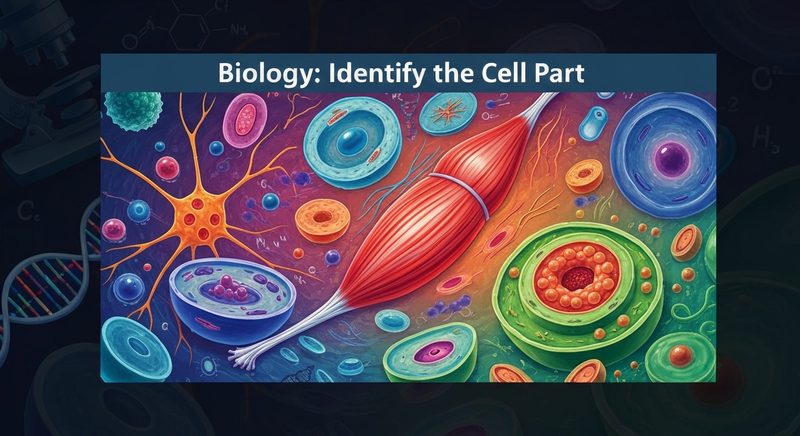
Eukaryotic cells are bustling microcosms, each organelle playing a specialized role crucial for cell function. The nucleus, often the largest organelle, acts as the cell's control center, housing its genetic material (DNA) and directing protein synthesis. Mitochondria are the "powerhouses" of the cell, generating adenosine triphosphate (ATP) through cellular respiration. Ribosomes are the sites of protein synthesis, while the endoplasmic reticulum (ER) comes in two forms: rough ER for protein modification, and smooth ER for lipid synthesis. The Golgi apparatus modifies, sorts, and packages proteins and lipids, lysosomes handle waste breakdown, and in plant cells, chloroplasts perform photosynthesis.
The Critical Skill of Cellular Identification
Accurately identifying cell parts is not merely an academic exercise; it's a critical skill with profound implications across scientific and medical fields. From diagnosing diseases like cancer, where abnormal cell morphology is a key indicator, to understanding pathogen infection mechanisms, visual cell identification is indispensable. Pioneering work in microscopy, from basic light microscopes to advanced electron microscopes, has allowed scientists to peer into cells with unprecedented detail. Researchers rely on this skill to differentiate cell types, study cellular responses to drugs, and unravel complex development processes. Mastery of cellular anatomy, as tested in this quiz, empowers individuals to interpret biological observations and contribute to scientific discovery.
Want more Science trivia? Try our Biology Quiz to test your broader biological knowledge, delve deeper into specific tissues with our Connective Tissue Quiz, challenge your classification skills with Sort Animals Into Classes, or explore significant scientific milestones in our Science Breakthroughs Slideshow!
 Picture
No comments yet. Be the first!